We are scientists and students investigating molecular systems and electronic processes
with computer simulation. Our group is based in the
Department of Physics
at the Faculty of Science,
University of South Bohemia
in České Budějovice, Czech Republic.
The group is led by Zdeněk Futera.
What we study
Research areas
01 / Bioelectronics
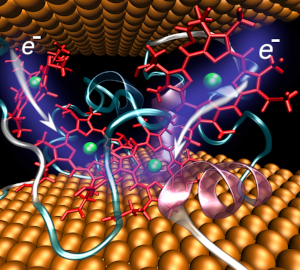
Electron transport in protein junctions
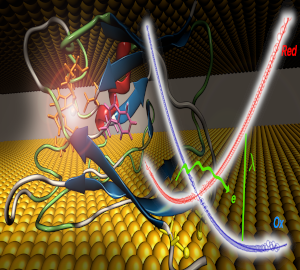
We study how electrons move through redox proteins connected to electrodes.
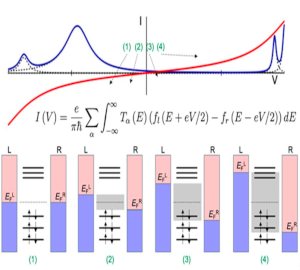
Our work examines when transport proceeds by hopping between redox sites
and when coherent tunneling can dominate.
We combine classical molecular dynamics, hybrid quantum-mechanical /
molecular-mechanical methods, and density functional theory.
Small tetraheme cytochrome junctionCoherent tunnelingAzurin junction
Selected publications
Futera, Z. et al. “Coherent Electron Transport across a 3 nm Bioelectronic
Junction Made of Multi-Heme Proteins.” J. Phys. Chem. Lett. 11,
9766 (2020).
DOI
Futera, Z. “Amino-Acid Interactions with the Au(111) Surface: Adsorption,
Band Alignment, and Interfacial Electronic Coupling.”
Phys. Chem. Chem. Phys. 23, 10257 (2021).
DOI
Kontkanen, O. V., Biriukov, D. & Futera, Z. “Reorganization Free Energy
of Copper Proteins in Solution, in Vacuum, and on Metal Surfaces.”
J. Chem. Phys. 156, 175101 (2022).
DOI
Kontkanen, O. V., Biriukov, D. & Futera, Z. “Applicability of Perturbed
Matrix Method for Charge Transfer Studies at Bio/Metallic Interfaces:
A Case of Azurin.” Phys. Chem. Chem. Phys. 25, 12479 (2023).
DOI
Futera, Z., Wu, X. & Blumberger, J. “Tunneling-to-Hopping Transition in
Multiheme Cytochrome Bioelectronic Junctions.”
J. Phys. Chem. Lett. 14, 445–452 (2023).
DOI
Jonnalagadda, G. N. et al. “Structural, Solvent, and Temperature Effects on
Protein Junction Conductance.” J. Phys. Chem. Lett. 15,
11608–11614 (2024).
DOI
02 / Interfaces
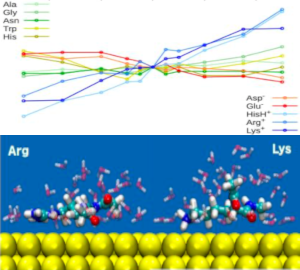
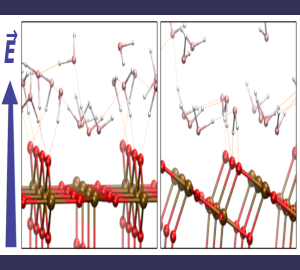
Electric fields at heterogeneous interfaces
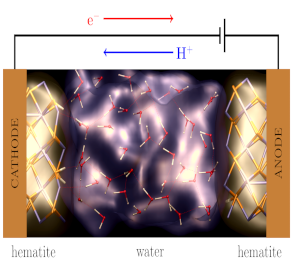
Applied electric fields can change the structure and electronic properties
of biomolecules at electrode surfaces. We investigate these effects and
field-driven chemistry at bio/metallic and aqueous interfaces.
Our simulations use non-equilibrium molecular dynamics, classical force
fields, and density functional theory.
Hematite/water electrochemical cellField response of adsorbed amino acidsAqueous titania/water interface
Selected publications
Futera, Z. & English, N. J. “Electric-Field Effects on Adsorbed-Water
Structural and Dynamical Properties of Rutile- and Anatase-TiO2
Surfaces.” J. Phys. Chem. C 120, 19603 (2016).
DOI
Futera, Z. & English, N. J. “Oscillating Electric-Field Effects on
Adsorbed Water at Rutile- and Anatase-TiO2 Surfaces.”
J. Chem. Phys. 145, 204706 (2016).
DOI
Biriukov, D. & Futera, Z. “Adsorption of Amino Acids at the Gold/Aqueous
Interface: Effect of an External Electric Field.”
J. Phys. Chem. C 125, 7856 (2021).
DOI
Futera, Z. & English, N. J. “Water Breakup at Fe2O3
– Hematite/Water Interfaces: Influence of External Electric Fields from
Nonequilibrium Ab Initio Molecular Dynamics.”
J. Phys. Chem. Lett. 12, 6818 (2021).
DOI